
ReSa - Be
Floorstanding 3way 12"+6"+1"+WG
Drivers: Scan Speak 32W/8878T11 and 18M/8631, Satori TW29BN-8, Jantzen WG
Concept: 3way with controlled directivity, bassreflex, separated W and MT cabinets
Impedance: 8ohm nominal, 5ohm at 90Hz
Sensitivity: 87dB/2.83V/1m
Dimensions: H W D
Crossovers: 300Hz and 2500Hz, LR2 acoustic slopes
After the experience with 32W/4878T00 in EllipsP project, where this woofer was in closed cabinet, I got even more curious in 32W T11 versions, which have rubber foam surround, one layer paper cone, and huge magnet instead of rubber surround and two layers paper cone with the foam in between. These are the main differences, and they translated to higher sensitivity and different parameters. T11 versions do not extend that low as T00+T01 versions, but higher sensitivity and, hopefully, better lower midrange performance are good tradeoffs. T11 models well in bassreflex cabinet with net volume ~65l and tuning ~29Hz with F-6 30Hz, and GD is <15ms. This is very good and promises excellent bass + lower midrange performace.
Synergy of the drivers, sound character matching, visual appearance matching, these are all aspects I value a lot and always strive to reflect them in my projects. Having these in mind, 18M/8631 was quite obvious choice for the midrange. Here we have rubber foam surround again, promising excellent midrange performance.
TW29BN + Jantzen WG measure excellent and I know this combination from my 2way project with W22NY003. For this project I wanted controlled directivity, so this option came to my mind immediately. Any form of small, shallow waveguide is from my experience always beneficial for sound quality and naturality due to improved off-axis behaviour in critical 2-6kHz band.
Crossover targets are ~300Hz and ~2500Hz, all LR2 filters. 18M has smooth top end rolloff without any breakups. TW29BN is very capable driver, but I do not want to push Fc as low as possible, it is actually better to let midrange driver handle as much as it can, and in this case, 18M has no issue in the top end, around 3kHz.
I did separated woofer and mid-tweeter cabinets. Woofer cabinet is quite wide, and the tweeter, despite being in the waveguide, would have the diffraction in the response around 2000Hz. To mitigate this, it is better to go with narrover cabinet, which pushes the diffractions higher in the frequency, where the driver starts to beam.
DRIVERS
32W/8878T11 woofer initial measurements look overall very good. NF measurement shows no issues of the drivers itself nor any resonances coming from the mounting in the cabinet or internal standing waves. There are also no severe breakups that would need to be taken care of, so LR2 should work well here.
T11 sensitivity in the system will be ~88dB/2.83V/1m, which is great for a 8ohm driver, and it was one of the reasons I wanted to use this specific version.
Distortion measurements look phenomenal. H3 is ~-60dB from 30Hz all the way above 1kHz even for 5.6V. H2 is also very low.
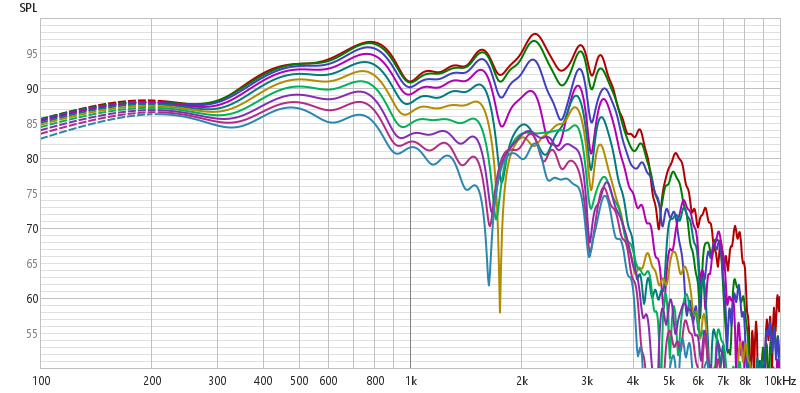


18M off axis performance is excellent and very consistent, even 90deg FR is good up to 6kHz. There is no breakup <9kHz. The mild breakup at 9kHz is the feature of the cone, I measured the same with 18W/4531G01. As soon as 9kHz is suppressed -20dB below system FR, there is no need to worry about this, and when I was listening to measurement sweeps there was nothing that would suggest an issue. The blip at 1.2kHz does not show related issue in impedance nor distortion, so it is likely combination of the feature of the cone and the cabinet or the damping inside the cabinet. I will explore this yet. Near field response is free of any breaks. Distortion measurement is perfect, the profiles are well behaved and very clean.
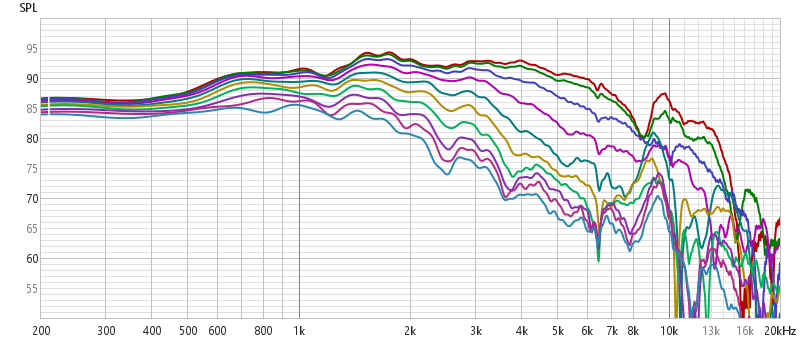


TW29BN in Jantzen WG measures perfect, there are no diffractions and this is also thank to narrow baffle. Distortion performance shows no issues and confirms this combo would be capable of lower and/or shallow crossover.
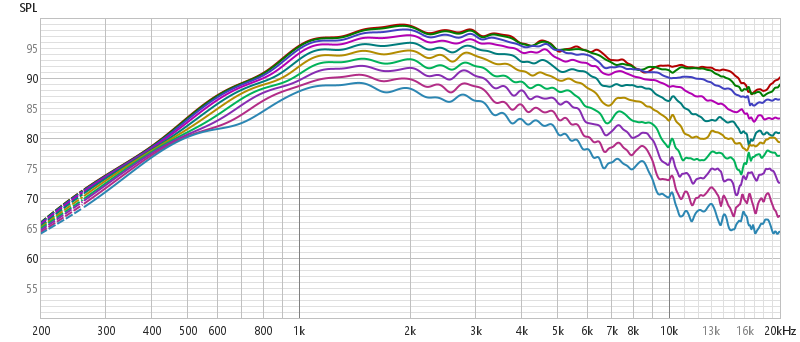

Crossover modelling
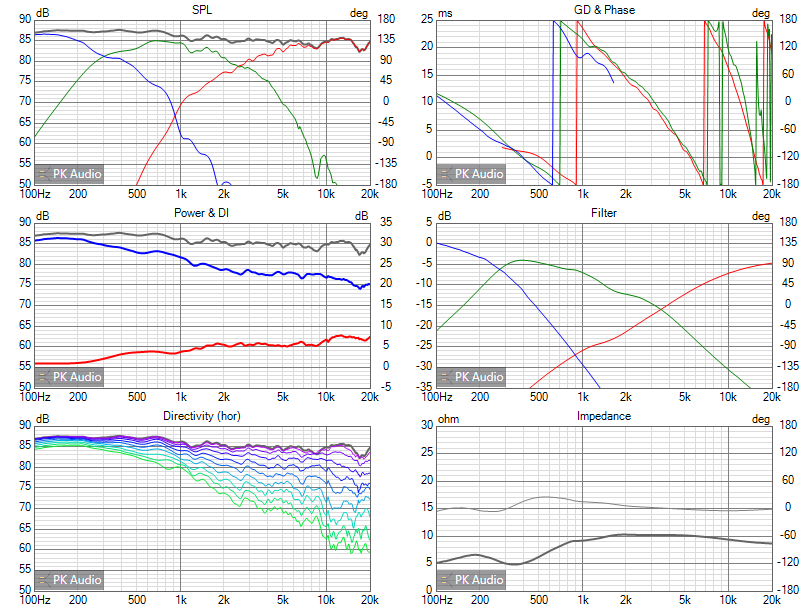
300Hz and 3000Hz were my initial targets for the crossovers and I was glad to see how well they work and that I did not have to change anything. All crossovers here are LR2, midrange drivers has reversed polarity. 18M upper rolloff was as smooth as it can be so it was very easy to make it follow LR2 rolloff. WG has depth ~30mm which is about right for good acoustic center alignment with the most of 6-7" drivers and here we have excellent phase matching at the Fc=3000Hz and also well below and above. Great, all worked as intended.
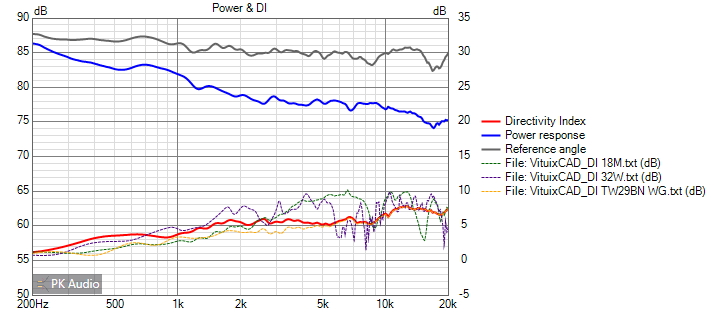
TW29BN in Jantzen WG has ecellent and consistent directivity at Fc and above, without any diffractions, and this goes well with 18M off axis responses. In this case TW29BN in WG has lower DI at 3kHz compared to 18M at 3kHz. The difference is 2dB, and this is case when LR2 is very suitable. Off axis responses will blend in the broader band on the both sides of Fc and it results in the smooth DI across entire band from the bass to the trebles.
The six-pack contains also vertical behavior, and represents the performance at the 3m distance and the listening axis at the midrange axis.
Overall FR has slight down tilt on axis, this proved to be needed after initial listening tests, to set the right midrange - trebles balance. I used TW29BN in Wg in another project, 2way with 8" midwoofer, and the FR shape was exactly the same.
Horizontal Polar map shows excellent directivity control. With DI ~5dB, this is somewhere between wide directivity and narrow directivity of large waveguides, typically large 2ways with PA drivers. DI ~5dB, and with controlled consistent off axis, this good solution for the most of the rooms. Too wide directivity is challenging in the most of the rooms and often creates sense of the wider image, which is given by the strong reflections from the side walls. Narrow directivity solutions can sound quite the opposite, image is somewhat closed in the loudspeakers, there is the sense of "large headphones".

Vertical Polar map shows what happens at the crossover points 300Hz and 3000Hz. At 300Hz there is no vertical lobbing, and the beamwidth is wide. This is given by the low crossover point, and also the CtC 320mm of midrange and woofer. At 3000Hz there are vertical zeroes at + and - 30deg vertically off axis. This is inevitable with non-coincident drivers (non-coaxials). In this case further off axis the situation improves, and this is the reason there is not the dip at Fc in Power response and related bump at Directivity Index. This is basically as good as it gets, and pushing Fc lower would not help much.

Here is Directivity Index breakdown. DIs of individual drivers are in dashed lines, and red is total DI. Here toal DI includes also vertical behavior.
FR 0-90deg of 18M midrange with the crossover.

FR 0-90deg of TW29BN in Jantzen WG with the crossover.

Final measurements
It is always needed to check that there were no errors during final assembly. With the complexity of the 3way loudspeakers it is easy to make wiring error, wrong polarity of some driver, or forgotten solder joint.
During this measurement of FR the loudspeakers were standing on the floor, and the mic distance was ~70cm, so not ideal. But still ok as even such a measurement can show assembly errors, and even more importantly can compare FRs of the both loudspekers.
In this case, measurement shown excellent match of both loudspeakers.

Measured impedance of the complete loudspeaker pair. Again, impedances match very well so final assembly was flawless.

The Sound
When I started the planning of this project I knew I wanted to do something similar to my previous Ellips-P. This time I wanted overall sound to be more relaxed yet still vivid, detailed and effortless, and this all with higher sensitivity, more friendly impedance profile, and LR2 crossovers.
T11 woofers had my attention as soon as they appeared on the market. Rubber foam surround, TS parameters and lighter cone promised good lower midrange hence LR2 feasibility. 18M midrange was obvious choice then, I had no hesitation here. Its FR linearity and smooth rolloff are always good signs. I knew TW29BN + Jantzen WG from one of my previous projects so this choice was clear.
Initial crossover, burn in crossover, sounded very good and it gives the early indication of much work with the tuning and voicing would be needed. This project sounded very good from the very beginning, drivers integration was great so it was clear that mild voicing to get the right tonal balance would be needed. I usually start addressing the most obvious aspects, in that case it was slightly present trebles >2kHz, so it took me few iterations of fine tuning of the levels in ~3-4kHz area and also top end. After that trebles got very nice open and clear character which I was after, without sounding harsh or fatiquing during longer listening sessions. 0,2-0,3dB changes do a lot of difference, which is even more obvious after several listenings. So this process takes the time. Beryllium tweeters are my favorite and they are step above aluminum or other hard dome tweeters in the trebles quality and naturalness.
The bass and lower midrange fine tuning came after the trebles. Initially the bass was little bit too hard and somewhat short, which causes listening fatique as well. I had change the tuning of the bassreflex from 26Hz to 28Hz and to the final 30Hz. In parallel I changed the amount of the damping material in the woofer and also MT cabinets. Though these changes do not bring significant measured changes, they have percievable effect and change the sound significantly. This took again several iterations, and together with also mild change in woofer and midrange crossovers it all led to the natural bass which had the right balance of the softness and weight, sounded effortlessly, had the right timing and the kick while was not too pushy.
Photos


