ErTac
2-way standmount loudspeaker 6"+1"
Basic concept: 2way, standmount loudspeaker
Drivers: Seas ER18RNX 6" reed paper cone, 27TAC/GB 1" aluminium dome
Woofer alignment: bassreflex, 18l
Crossover: 3000Hz, acoustic LR2 slopes
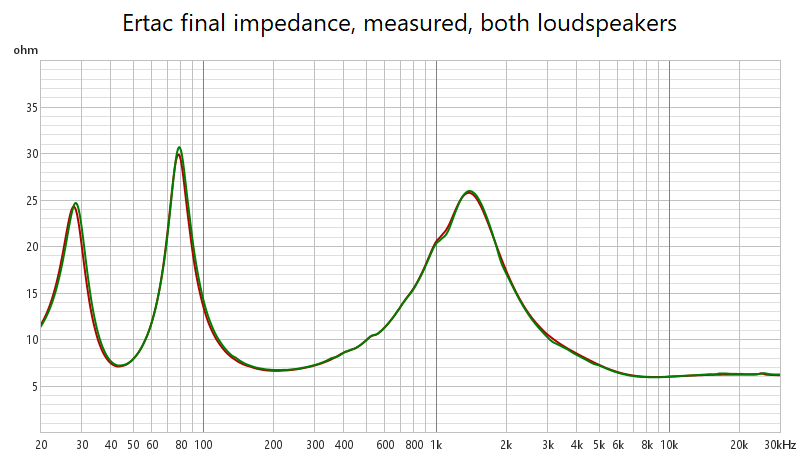
Impedance: 8ohm nominal, 6.7ohm minimum at 200Hz
Sensitivity: ~85dB/2.83V/1m
Dimensions: H390 x W230 x D370
Since ClassIllu project (Scan Speak 18W/8545K00 + 6600) I had these cabinets around, as I got 2 pairs. My hifi friend is still very happy with ClassIllu and I have been thinking what to do with this pair of these beautiful walnut veneered cabinets.
This time I wanted to try more budget friendly drivers, and Seas ER18 came to my mind. As the cabinets has tilted baffle, I was looking for the driver capable of LR2 crossover. ER18 did not have my attention before, so I did just quick research of available measurements and the projects. I also checked if 18l BR was suitable alignment. This confirmed 18l could be the sweet spot, as 14l seemed to limit low end extension. 6" midwoofer in 2way has quite difficult role, as it has to play both bass and midrange with at least reasonable quality. There are the drivers which can do both at very high quality, Purifi PTT6.5, 18W Revelator, 18WU Illuminator, W18NX003, just to name a few, but there is always the sweetspot for optimal volume providing good bass extension and uncompromised midrange (with the constraints of 2way loudspeakers). ER18 models well in larger volume, ~21l, but would it sound good, it is hard to tell. As always, one has to try and listen.
27TAC was quite easy decision. I know this tweeter from 2way with Purifi PTT, and I had basically no complaints. It is not the most detailed driver yet in terms of clarity it is step above the most of soft dome drivers of similar cost. I was considering SB26ADC, but the cutout was 104mm and I did not want to bother with adaptor rings. I also recall I was not particullarly impressed with the sound of ADC, so I would likely go with CDC, if the cutout in the cabinet was right. Anyway, 27TAC had 104mm and 6mm flange thickness, exactly what I needed.
I was also considering making the plans for this loudspeaker available for the DIYers, as simple cabinet construction, reasonably complex crossover, broadly available drivers and good sound made it suitable for easily reproducible DIY project, and the plans are now available.
Measurements of the complete loudspeaker pair
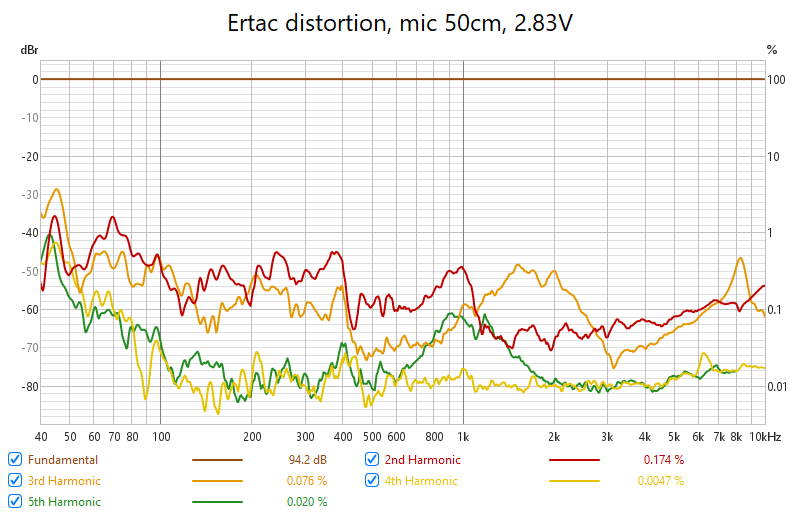
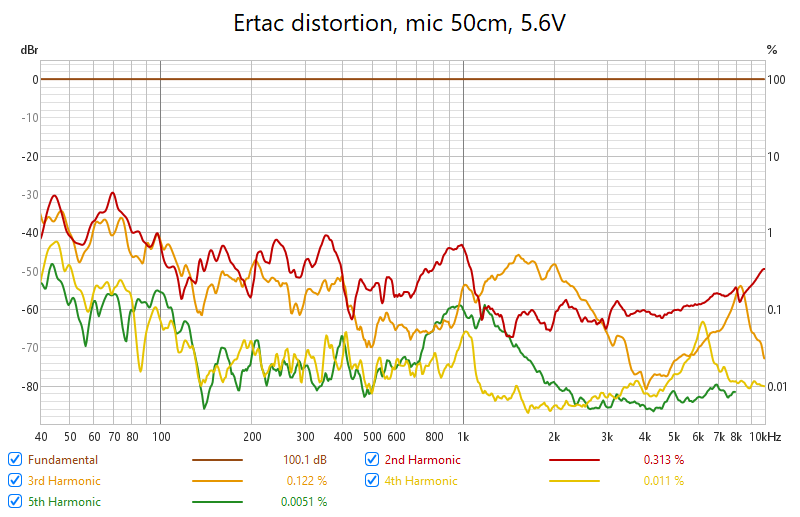
Measurements were done with microphone reference axis as shown below. Microphone distance 1m from reference point on the front baffle for FR measurements, and 50cm for the distortion. SPL was calibrated, so FR SPL is accurate. Measurement voltage was 2.83V for FR, and 2.83V and 5.6V for the distortion, which translates to 85dB/1m and 91dB/1m.

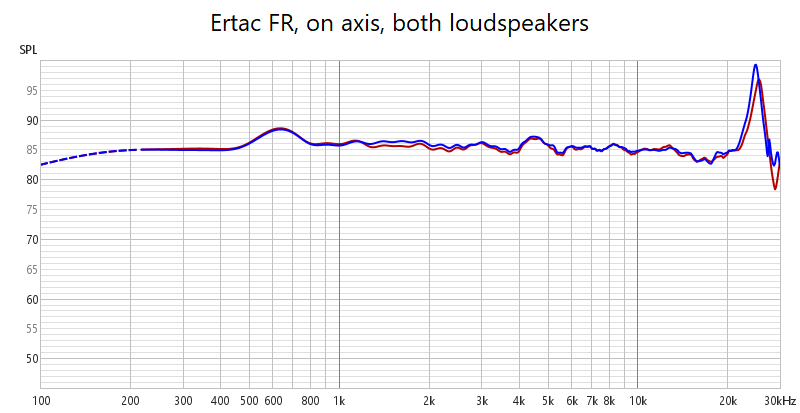
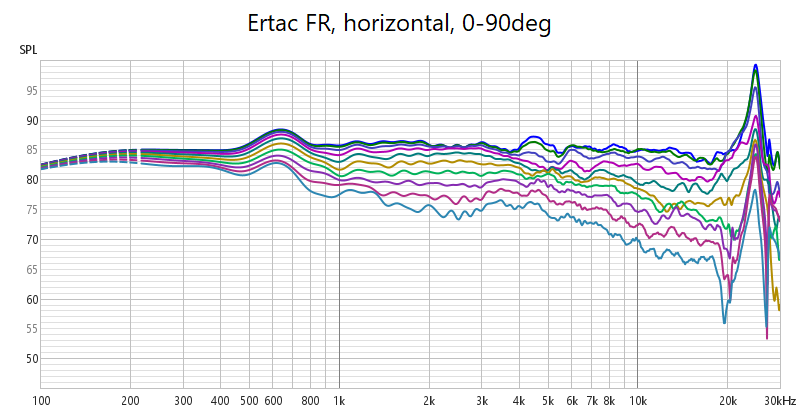
Comparison of on axis FRs of both loudspeakers is below on the left. FRs match very well. FRs horizontal 0-90g is on the right. The directivity is quite wide, -7dB at 10kHz on axis versus 60deg off axis. The off axis behavior is very consistent and smooth, no sudden change of the directivity. Also there is almost no sign of the diffractions
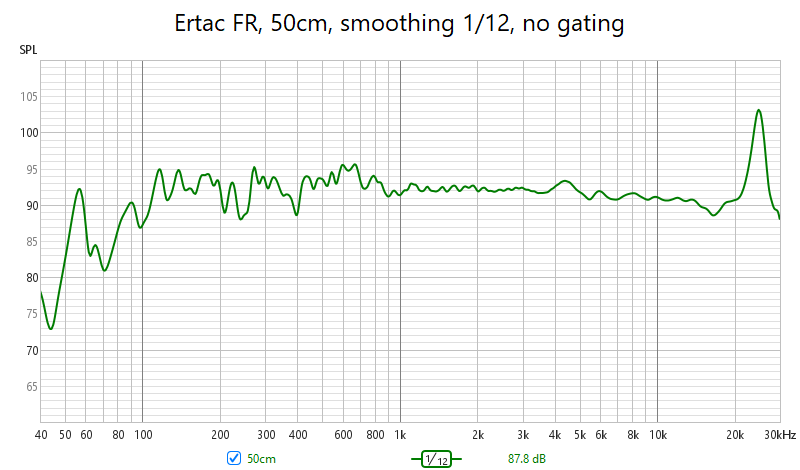
On the left FR at 50cm measurement, smoothing 1/12, no gating. On the right, final impedance of both loudspeakers, the match is very good.
Distortion measurements. Measurement voltage was 2.83V for FR, and 2.83V and 5.6V for the distortion, which translates to 85dB/1m and 91dB/1m. Mic distance 50cm to capture the response of both tweeter and the midwoofer.
Nearfield measurements of ER18 with port open and port closed, and Port NF. Port NF is well behaved, shows standard and clean port response and tuning, and parasitic resonances are well suppressed. On the right, merged Farfield response to ER18 Nearfield+Port NF+Baffle step response.


Drivers measurements
ER18RNX
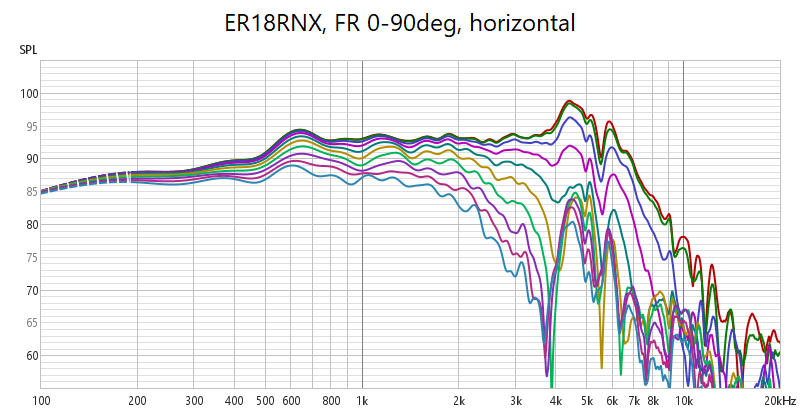

This is very good off axis performance. The overall linearity is great.
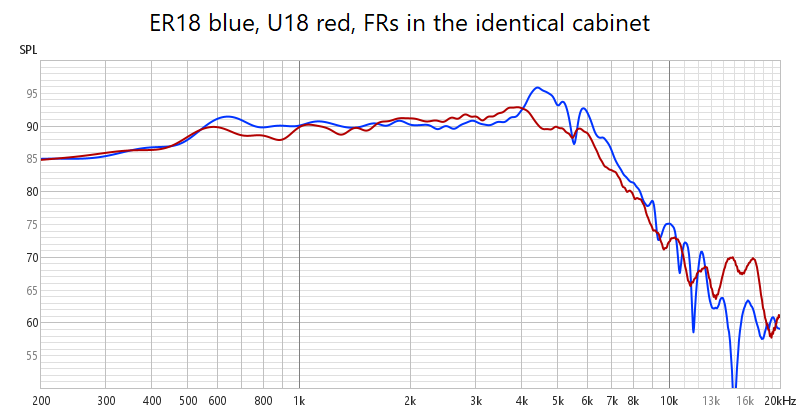
Minor breakup at ~4-5kHz is well behaved, with low Q. Its presence was noticeable during measurement sweep, but it was not sharp piercing sound typical for aluminium cones. This is a good sign, it will need the attention in the crossover, but once it is forced to follow LR2 slope, there are no sonic signatures of the breakup left.
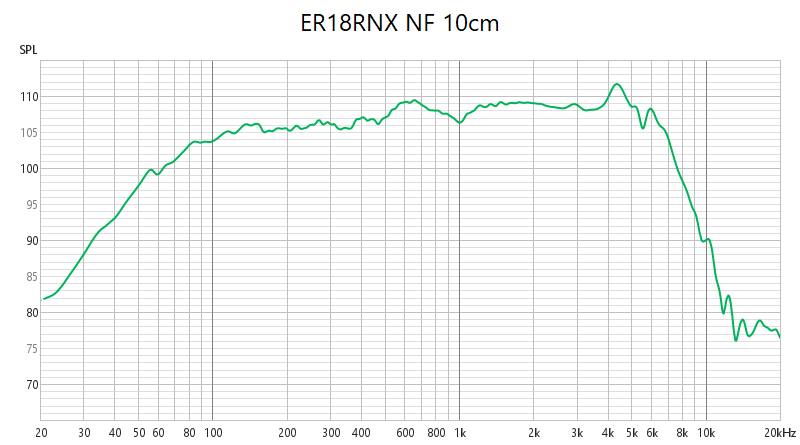
600Hz mild bump or similar issue are quite typical for many 6-7inch midwoofers, and Seas specifically. It is nothing to be concerned about though. Distortion is clean in that area. NF measurement shows similar bump as FF measurement. Waterfall is is also clean in that area. So the question is if this will have any impact to the sound and this will be discussed further.
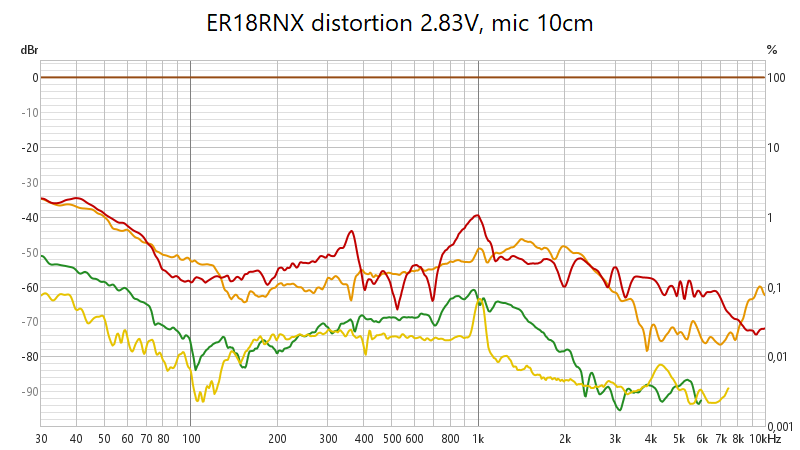
H2 red, H3 orange, H4 green, H5 yellow. Overall these are good levels of the distortion and there is no significant issue.
600Hz area is clean, does not show any signs of the resonance.
Nearfield measurement 10cm. This is not exactly nearfield distance though. I measure the distortion at 10cm distance, so here is the FR with 1/12 smoothing.
Waterfall is also very clean. 500-1200Hz and 4-6kHz were the areas of the main concern.
There is no sign of delayed energy in 600Hz region.
4-5kHz mild breakup is well behaved, as soon as it is linearised by the crossover, any signs of the breakup dissappear. Additionally, this region will be ~-12dB below loudspeaker on axis response.
Comparison of ER18 and U18, measured at the same conditions. U18 has less pronounced breakup, or actually no breakup at all
27TAC/GB


0 - 60deg difference -8dB is good value for 1" dome and overall directivity is lower and maintained above 10kHz compared to the most 1" domes. The diffraction at 3kHz was expected and can be dealt with in the crossover. Breakup is at 27kHz and its suppression with LRC will be tried.
The off axis responses 15-20kHz were likely caused by not proper alignment of the tweeter faceplate and the baffle, there might have been 0.5mm step. As this tweeter has wide directivity up to 20kHz, it is more sensitive to proper countersink. Final measurements of the completed loudspeakers show this was solved and tweeter has excellent off axis response.
On axis FR measurements to see the matched pair performance, and breakup frequencies.
Crossover modelling

Symetric acoustic LR2 crossover slopes were the intention since the beginning, and this dictated crossover frequency. From one side we have a tweeter, with Fs ~900Hz, which means Fc 3000Hz LR2 as likely the minimum, or lower crossover with higher slope. From the other side we have ER18 with its breakup at 5kHz and good off axis performance. Fortunately ER18 breakup is mild, it can be easily heard during the measurements sweep, but it does not pierce your ears, so it does not require aggressive suppression in the crossover and/or steep crossover slopes. ER18 off axis starts to fall apart above 2kHz, which is generally considered bad thing, but things are not that easy and in reality of speaker design and more specifically crossover design some features or issues can be easily mitigated or suitably compensated. In this case I will use rising midwoofer directivity above 2kHz to compensate for tweeter diffraction at 3kHz. I consider this better compromise than pushing the crossover low (based on many many realized projects and the listening tests). 3-6kHz area is often very troublesome and requires fine tuning by ears, and the directivity in that area is the key. As the most of the tweeters has very wide directivity in that region, it is good to compensate that with the right crossover frequency and the slopes to achieve little bit higher directivity compared to raw tweeter, optimally the directivity close to the directivities below and above Fc, which minimized the "S" swing of Directivity Index, so much typical for 6"+1" 2ways.
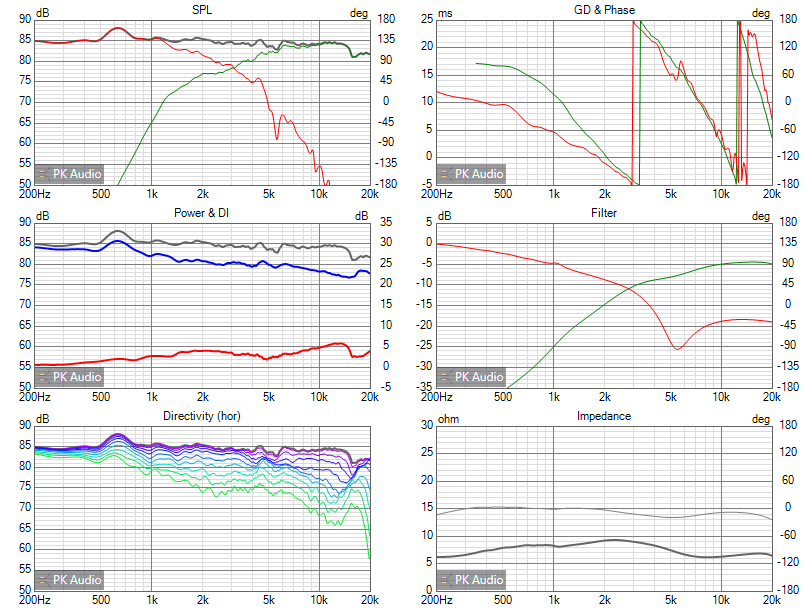
Here is the first crossover version I will start the listening tests with. Phase matching and tracking is excellent. Tweeter response is -25dB at 1kHz (see the Filter plot), which is good rule of thumb for the tweeter SPL at its Fs resonant frequency. Midwoofer rolloff follows LR2 slope, while tweeter rolloff deviates from the slope below Fc just slighly, which is often the case in reality. Fully symetric slopes are possible when acoustic centers of the drivers are aligned and when the native drivers responses allow LR2 slopes with the crossover. In this case it is reasonable to call it symetric LR2.
Mild "S" shape of Directivity index is still very good example of well executed crossover and the drivers transition in terms of the smooth directivity. This is also indicated by the smooth downtilt of the power response.
There are 3 optional circuits in the crossover, and I did not use either of them. They still might be of benefit for some builders, so here is the description and the recommendations:
1. Impedance compensation of the 1500Hz impedance peak. Solid line is with the circuit connected.


2. 600Hz bump compensation RLC. I did try, and the midrange got too laid back and somewhat suffocated, it lost the clarity and naturallness. But if you are curious you may try and hear for yourself.
Here is Directivity index breakdown. DI in red is for the whole loudspeaker, vertical behavior included. Three dashed DIs are for the drivers individually, green for ER18, purple for 27TAC, and orange for the whole loudspeaker with horizontal directivity only.
ER18 has smoothly rising DI which is always good thing and makes crossover design easier and does not represent the issues or constraints.
27TAC DI has the minimum at 3kHz, exactly the center of the diffraction. LR2 slopes merge the directivities of the drivers in a good way, and 3kHz crossover is optimal. This is also confirmed by the crossover modelling with LR4 slopes, 3kHz crossover worked the best. To make this work and sound good, midwoofer must have the linearity well above crossover frequency and well behaved breakup.
Red vs orange: shows clearly the impact of the vertical directivity to the DI.

The Sound
Ertac, thanks to its size and great ER18 driver, offers very good bass extension and the size in terms of 2way loudspeakers and 6-7 inch midwoofer size, while maintaining great and clean lower midrange and the midrange. In that respect, 18l BR cabinet seems to be an optimum, with the good balance of the midrange quality and the bass extension. Ertacs can handle quite high SPL without sounding unpleasant.
Ertac's overall sound character is well balanced with sound clarity and the details. Thanks to 27TAC there is no hint of hiss, harshness or certain veil in the critical 3-6kHz region, so much typical with soft domes. I paid careful attention to the voicing of this loudspeaker to make sure it can handle various music genres well. It can play classical music as well as rock and electronic. The top end of the trebles is nicely extended, it has a certain lightness, openness. Midrange region well connects bass and the trebles, crossover is sonically seamless, and it all results in easy to listen and smooth character, and detailed natural sound without dullness or sharper signature.
The left-right soundstage is wide and has a well defined position of the instruments in the recording. The front-rear soundstage is also deep and well defined, the center of the image is slightly in front of the loudspeakers, the sound is not laid back.
Good horizontal dispersion and well behaved off axis response is very room acoustics friendly. Ertacs were developed for free space placement, further from the walls, but can be placed closer to the wall behind them without sounding too boomy and bass heavy.


