
Merak
2-way standmount loudspeaker 7" +1" + WG
Drivers:
- 7inch midwoofer Scan Speak 18W/4531G01 Revelator
- 1inch silk dome tweeter Bliesma T25S
Concept: 2 way standmount loudspeaker, Waveguide/Controlled directivity
Cabinet/Woofer alignment: Bassreflex
Crossover: ~2900Hz LR2 acoustic
Sensitivity: 87dB/2.83V/1m
Impedance: 4ohm nominal, 3.8ohm@170Hz minimum
Dimensions: H450 x D370 x W240 mm
This project started to get the outlines in my had when I was asked to measure T25B and T25S tweeters in the waveguides friend of mine was developing. After seeing all that the measured performance was really good, the project idea got more concrete shape.
I wanted the midwoofer with well behaved rolloff being capable of LR2 acoustic. It has been a while since I had worked with Revelator drivers so I was keen on refreshing the experience and the impressions. There were few question marks, mostly about the suitable net volume and port tuning, this all related to higher Qes and Qts. I decided to mount additional magnets to lower Qs a bit, making the driver more suitable for vented alignment, and it also improves subjective quality and clarity of the midrange. All to be tested and proven by the measurements and the listening.
T25S and all T25 tweetes are not suitable for low and shallow crossovers so if I wanted to make this work with LR2 crossover I had to push out the crossover to ~3000Hz area and this meant even more strict requirements for midwoofer and its top end rolloff.
As I had prototype cabinets around, I took a quick decision and took all the measurements, initial crossover design and listening during one week to confirm this combo could work. To my surprise all peices of the project worked in harmony with each other and it ended up with very simple crossover. After that I spent few weeks listening and the tweaking the crossover and the more I worked on it the more I knew I would want to finish this and make the final loudspeaker pair.
Drivers measurements
18W/4531G01
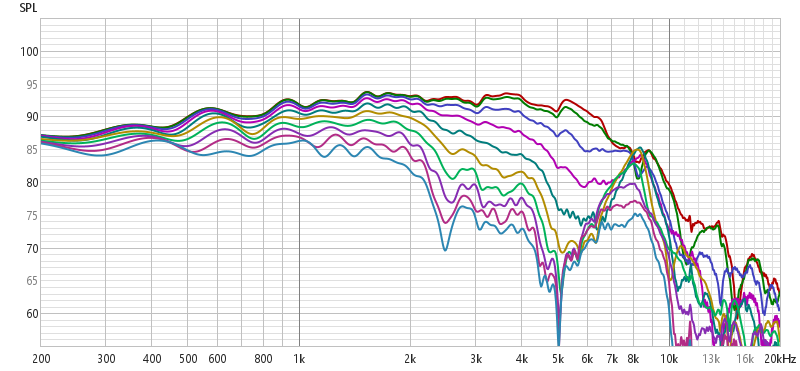
Datasheet responses promised very linear behavious though you can never be sure about the impact of the real baffle. It can be simulated though. I usually follow few rules to avoid the issues, so I the place midwoofer few centimeters from the lower baffle edge. Distances to the side edges are usually the shortest. This mitigates baffle induced ripples a lot. I also added R30 roundovers, this usually helps a lot as well. These two measures worked well in synergy and resulted in excellent on and off axis linearity.
There is slight resonance at 8kHz, it is nothing to be concerned of, but it is good not to understimate this, so I knew I wanted to have this suppressed at least 20dB below system FR.
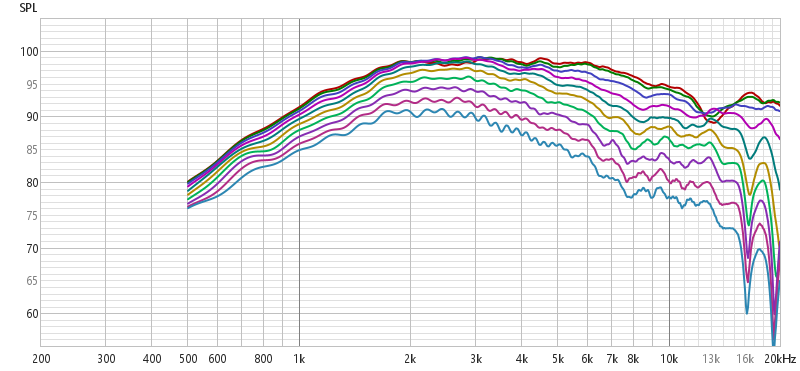
T25S + Waveguide
I knew the measurements from prototype baffles, so for this project I decided to make the measurements as perfect as possible. That is the reason why I placed the tweeter closer to the one side and rounded the edges of the baffle. It all paid off and contributed to the great measured performance. On and Off axis linearity and consistency are as good as it gets. There is small diffraction at 13kHz though, which suggests additional WG profile optimization would be needed. I decided to assess this as low risk and not an issue for the overall performance and the sound.
Crossover design
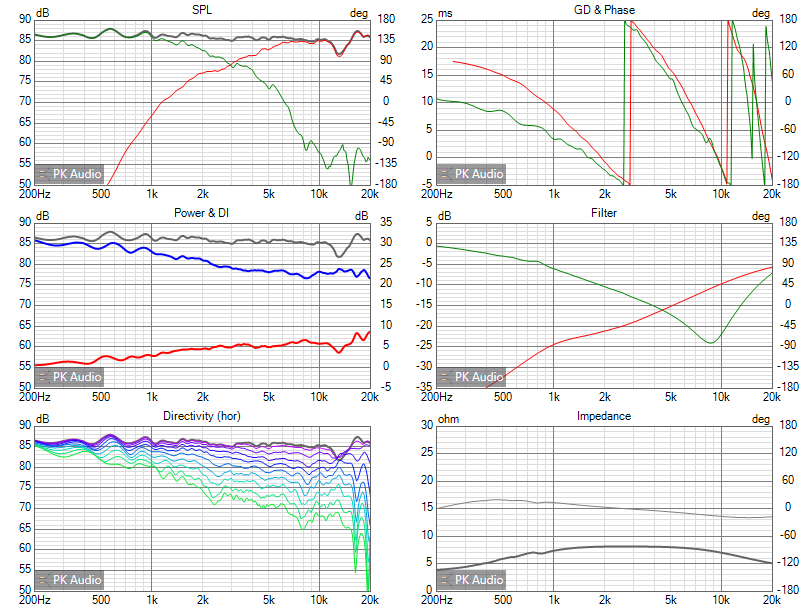
For this project I had LR2 targets in mind. Drivers measurements looked very good and were promising simple crossover as there were no significant issues to address with the additional crossover components. The only question mark was in the phases, more specifically if it was possible to achieve good phase matching with LR2 and straight front baffle.
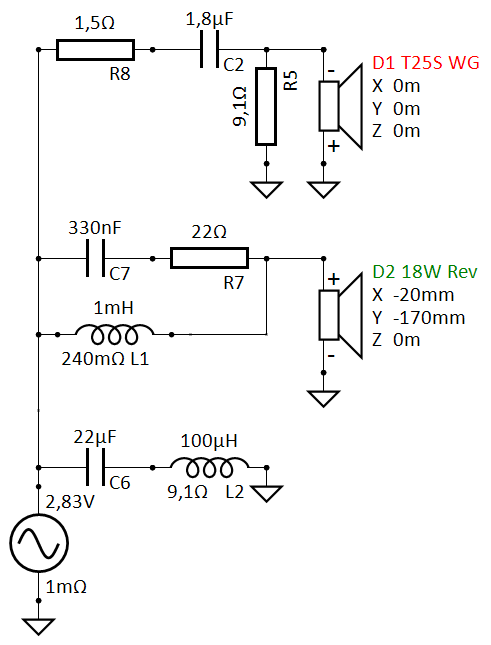
Vituix six-pack below shows the situation for the listening axis at the tweeter height (note Y coordinate 0m in the crossover schematics, this determines listening axis or more precisely the axis for which the graphs are shown for), SPL is calibrated and graphs referenced to 1m. Mic distance for crossover modelling was set to 3m so the graphs represent the traces in 3m distance.
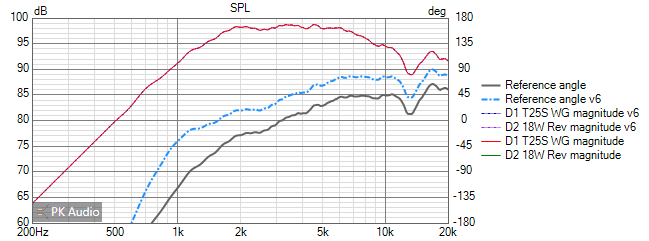
C2 realizes tweeter filter and with the native response of the tweeter it results in LR2 slope. C2 also realizes tweeter level padding partially. R8 adjusts top end level, >8kHz, and increases the impedance. R5 realizes tweeter level padding and more importantly it dampens Fs impedance peak of the tweeter and linearizes the response in 1kHz area.
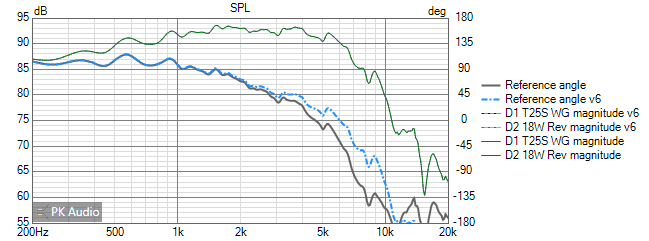
Midwoofer crossover is as simple as it gets. C7 + R7 suppresses the resonance at 8kHz by 7dB.
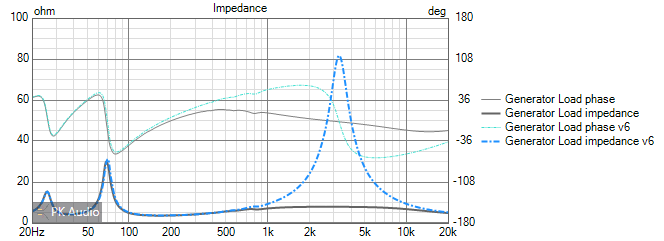
C6 + L2 is impedance compensation at ~3kHz.
These two graphs demonstrate the effect of R5. Level padding by ~4dB, and mild linearization/suppression of 1kHz bump due to Tweeter Fs impedance peak.
Red = tweeter native response, blue with R8 + C2, black with full tweeter crossover.

Green = midwoofer native response, blue is with L1 only, and black is full midwoofer crossover (C7 + R7). C7 + L7 helps to suppress 8k mild resonance by ~7dB, which is significant.
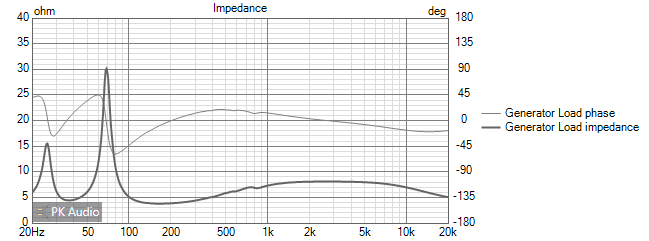
Impedance graph shows well behaved impedance profile. Two peaks are characteristic for vented alignment. The minimum impedance is 3.7ohm which is great value for 4ohm nominal loudspeaker. The second graph shows the effect of C6 + L2 impedance compensation.
Full spinorama plots. From my experience, once you get DI, power reponse and FR on axis looking reasonably good and linear, ER+ERDI+In-room+Listening window look good and linear as well.

Here is Total Di, and DIs for each driver separately. Note that Total DI is influenced by vertical behavior of the two non-coincident drivers.
Tweeter DI at 3kHz is 3dB, midwoofer DI 6dB. This is the case where LR2 crossover helps to merge the drivers directivities without sharper DI changes, and when we add typical DI bump at Fc because of vertical behaviour, the results is smooth and rising DI without sharper changes or S-shape profile.

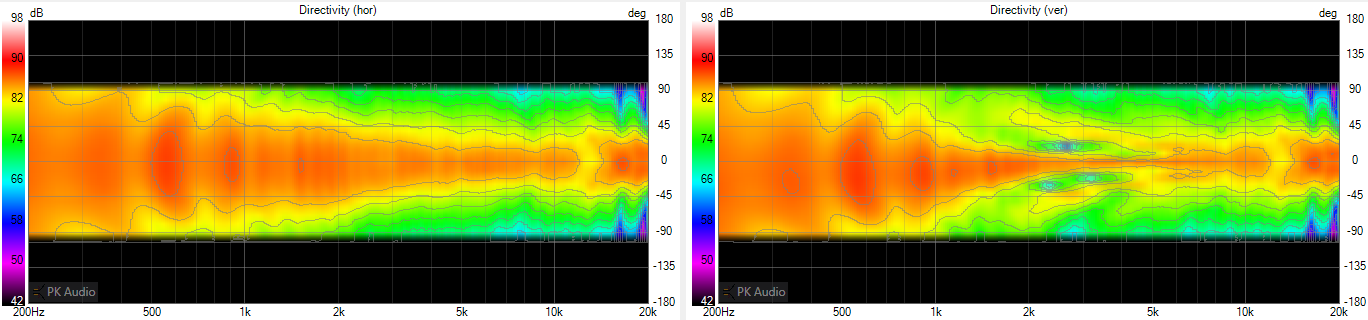
Horizontal and Vertical polar maps.
Horizontal map shows the typical results of good waveguide implementation. Vertical map shows the typical off axis nulls at ~ + and - 30deg.
Final measurements
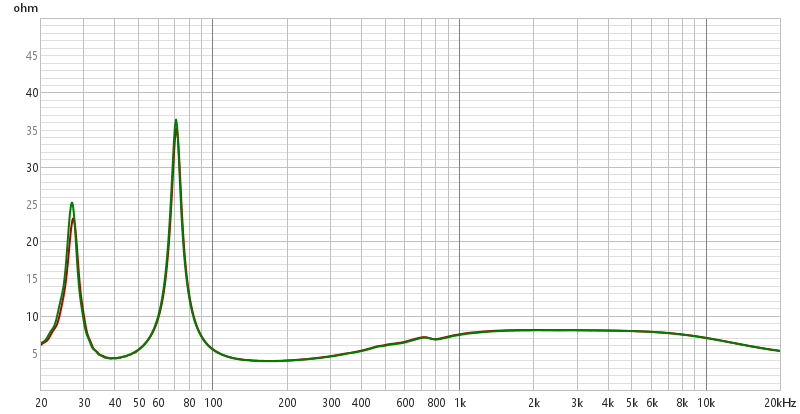
Control measurement of the impedance of both loudspeaker after final assembly.
Both loudspeaker's impedance match the modelled impedance well, and as a pair, their impedances match perfectly.
The Sound
I had very high expectations from this 2way project. 18W revelators are well known for their bass and smooth midrange. T25S sound was on the other hand quite unknown. The most important thing was to hit the right net volume for 18W. The implementations differ in that regard a lot, from ~15l closed to ~33l vented. I expected 33l vented would lead to too heavy and slow bass and veiled midrange, so I started with 25l, which showed to be still to much, so I reduced the volume to 22l. 25l might be good when this weefer is used for woofer duty only. With 22l net volume things snapped into the the place, bass was still admirable for 7inch midwoofer, and more importantly midrange got clarity and naturallness. When I mean clarity, it is as good as it gets from paper cone midwoofer. It has the clarity that does not attract the attention, it is smooth, full and rich. I assume added magnet contributed to that a lot.
Transition to the trebles is seamless. It is just another confirmation that midrange covering all the midrange up to ~3kHz has something right, there is certain coherency and fullness in the human voices. ~2kHz crossovers sound good as well, it just somewhat emphasizes ~3kHz area and the overall sound is not that smooth. Of course, these are just my generalizations and impressions, though based on many experiences and projects.
T25S was quite a surprise, the trebles has certain power, they sound strong, there is certain body, but also lightness and clarity and top end sparkle, they are very resolving. Though it is silk dome, there is certain resemblance of the sound with T25B. It is different presentation compared to Scan Speak and Satori soft domes. Though I have to admit that in this case the waveguide has its contribution to how T25S sounds in this specific implementation. I did a lot of projects with waveguided domes, and it always paid of implementing the waveguide, it brings more lightness and clarity to the trebles, and less scratchy, hiss, and harsh character. Domes without waveguides are more difficult to integrate and to make sounding right.
Photos


